
Exchange of Experiences in Microscopy (IdEM) 2026
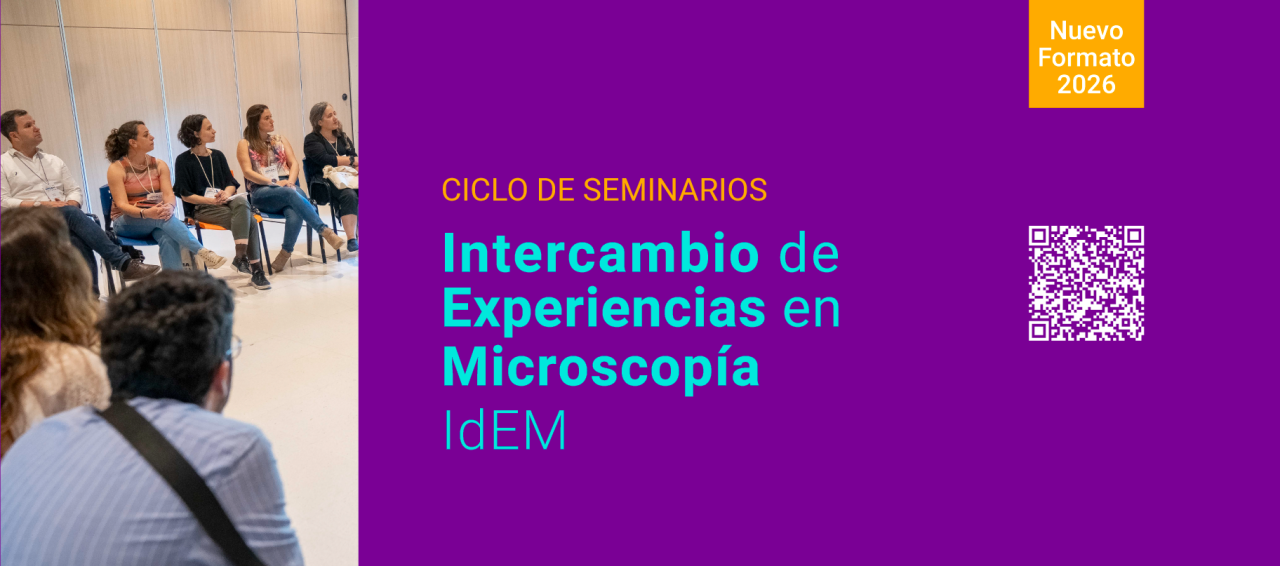
Our virtual space Intercambio de Experiencias en Microscopía – IdEM is back, organized by the Training & Education Working Group. This 2026 Cycle is titled: “Microscopy in Practice – Behind-the-Scenes Experiences in Bioimaging“
- Modality: Virtual (with registration)
- Time: 12:00 h (GMT-3) Duration: 60 minutes
New Interactive Format 2026
This year, IdEM will be even more interactive. Guests, live questions, and audience participation through chat, microphone, and Mentimeter, generating real-time exchange between guests and the community.
Each session will include:
- 3 Guests sharing experiences and questions
- Active participation via chat, microphone, and Mentimeter
- Real-time exchange between speakers and audience
- Key questions we will explore together
Session structure:
- Welcome and connection to Mentimeter
- Presentation of speakers and moderator
- Interactive Q&A cycle between moderator, speakers, and participants
- Closing and upcoming sessions
The talks will be in Spanish and Portuguese.
Session 1. Getting to Know Each Other: Hidden Wisdom in Microscopy Core Facilities
- Thursday, June 4 – 12:00 (GMT-3)
Description: Behind every cover image there is an expert technician and a logistical challenge that few ever see. We open the 2026 cycle by inviting you to discover the secrets inside a Core Facility — insights that will help you make the most of your time at the microscope. Join the conversation with those responsible for day-to-day operations at different centers across Latin America as we answer what every microscopist needs to know.
Key questions:
- The “Unwritten Manual”: What is the #1 mistake that ruins your images?
- What artifacts are common in Fluorescence and Electron Microscopy?
- Autonomy or assistance? How long does it take to become an expert?
- Data, not just photos: How to turn pixels into quantitative science.
Guests:
- Nicole Salgado (Santiago, Chile)
- Carlos Mas (CEMINCO, CONICET – Universidad Nacional de Córdoba, Argentina)
- Juan Orozco (MicroCore, Universidad de los Andes, Colombia)
Moderators:
- Iván Rey
- Victoria Repetto
Session 2. Volumetric Microscopy: From 2D to 3D in Practice
- Thursday, July 2 – 12:00 (GMT-3)
Description: Volumetric microscopy has revolutionized our ability to understand three-dimensional structures, but implementing it in daily practice presents unique challenges. In this session we will explore different approaches to 3D imaging: from confocal and lightsheet microscopy to volumetric electron microscopy techniques. We will share experiences on sample preparation, acquisition protocol optimization, and strategies for managing and analyzing large data volumes. We will discuss which technique to choose based on the biological system, available resources, and the scientific questions we want to answer.
Key questions:
- What volumetric technique do you use most frequently and why?
- What is your main challenge in sample preparation for 3D imaging?
- How do you manage the storage and processing of large volumetric datasets?
- What software/pipeline do you use for 3D image analysis?
- How much time do you typically spend optimizing a 3D acquisition protocol?
- What advice would you give to someone just starting out with volumetric microscopy?
Guests:
- Carmen Gloria Lemus (Universidad de Chile)
- Sandra Villanueva (Universidad de Valdivia, Chile)
- Humberto Joca (CNPEM, Brasil)
Moderator:
- Aníbal Vargas (LiSIUM, UM, Santiago de Chile)
Session 3. Microscopy in Neurons: Visualizing the Nervous System
- Thursday, July 30 – 12:00 (GMT-3)
Description: Nervous tissue presents unique challenges for microscopy due to its structural complexity, fragility, and the spatial scales that must be covered — from nanometric synapses to millimeter-scale neural networks. In this session we will share practical experiences working with neurons: from cell cultures to intact brain tissue. We will discuss labeling strategies, clearing techniques for dense tissue, approaches for imaging live versus fixed cells, and how to capture both fine morphology and functional activity. We will explore what has worked (and what hasn’t!) when attempting to visualize the extraordinary complexity of the nervous system.
Key questions:
- What system do you work with most: neuronal cultures, slices, or intact tissue?
- What is your greatest technical challenge when imaging neurons?
- What labeling/contrast method do you prefer for your system and why?
- Have you used tissue clearing techniques? Which one, and with what results?
- How do you balance spatial vs. temporal resolution in functional imaging?
- What do you wish you had known before starting to do microscopy in neurons?
Guests:
- Begoña Aranda (Universidad Mayor, Chile)
- Giuliana Gonzalez (Universidad de la República, Uruguay)
- Clara Chungara (Instituto Ferreyra, Argentina)
Moderator:
- Luciana Gallo
Session 4. Image Analysis in Daily Practice: From Pixels to Papers
- Thursday, September 24 – 12:00 (GMT-3)
Description: Acquiring beautiful images is just the beginning — transforming them into robust quantitative data is where the science happens. In this session we will share practical analysis workflows used on a daily basis: from basic pre-processing to automated segmentation and quantification. We will discuss which tools to choose based on the type of analysis (Fiji/ImageJ, CellProfiler, ilastik, QuPath, Python, or commercial tools), how to validate our analysis methods, batch processing strategies, and best practices for documenting reproducible pipelines. We will also share our most common mistakes and how we detected and corrected them.
Key questions:
- What analysis tool(s) do you use most frequently?
- What is your greatest challenge in image analysis?
- How do you decide whether manual vs. automated analysis is more appropriate?
- What strategy do you use to validate that your analysis pipeline works correctly?
- How do you document your analysis to ensure reproducibility?
- Have you found any “trick” or best practice that significantly improved your analysis?
Guests:
- Andrea Lara (Universidad Galileo, Guatemala).
- Mauricio Cerda (Universidad de Chile, Chile).
- Agustín Corbat (Universidad de Buenos Aires, Argentina)
Moderator:
- Lorena Sigaut
Session 5. Intravital Imaging: Seeing Life in Action
- Thursday, October 22 – 12:00 (GMT-3)
Description: Intravital imaging allows us to observe biological processes in living organisms, but it requires overcoming unique technical and biological challenges. In this session we will share practical experiences with different intravital microscopy approaches: from imaging transparent embryos to surgical windows in mammalian models. We will discuss animal preparation, sample stabilization during acquisition, motion management and physiological signals, labeling strategies that minimize perturbation, and ethical considerations. We will explore how to obtain informative data while keeping the organism under the most natural physiological conditions possible.
Key questions:
- What model/organism do you use for intravital imaging and why did you choose it?
- What is your main strategy for stabilizing the sample during acquisition?
- How do you manage motion due to breathing/circulation?
- What fluorescent markers have given you the best results in vivo?
- What has been your greatest technical or ethical challenge in intravital imaging?
- What maximum duration have you achieved in imaging sessions without compromising the animal?
Guests:
- Maisa Antunes (Universidade Federal de Minas Gerais, Brazil)
- Agustina Frechou (The Rockefeller University, USA – Uruguay)
- Hellen Ishikawa-Ankerhold (Ludwig-Maximilians-Universität München, GER – Brazil)
Moderator:
- Iván Rey (The Rockefeller University, USA – Colombia)
Session 6. Getting to Know Each Other: Latin American Core Facilities on the Move
- Thursday, December 3 – 12:00 (GMT-3)
Description: We close the 2026 cycle by taking a close look at how different core facilities in Latin America operate, this time focusing on how they innovate and sustain themselves over time. Three facilities will share their strategies for staying technologically up to date with limited budgets, how they generate value for their institutions, their funding models (internal, external, mixed), and how they measure and communicate their impact. We will also discuss how these facilities are incorporating new trends (AI, data management, multimodal imaging) and preparing for the future. An opportunity to learn not only what facilities do, but how they ensure they can keep doing it.
Key questions:
- What is your funding model and how sustainable do you consider it?
- How do you justify investments in new equipment/technologies to your institution?
- What metrics do you use to demonstrate the impact/value of your facility?
- How do you stay current with new technologies without large budgets?
- What recent innovation did you implement and how did it turn out?
- What is your vision for your facility over the next 3–5 years?
Guests:
- TBD – 3 facilities different from those in May, ideally from different countries
Moderators:
- Iván Rey / Victoria Repetto
Want to be part of IdEM?
Do you have an experience to share? This space is collaborative and is built by the entire LABI community!
- Propose a topic for future cycles
- Participate as a speaker sharing your expertise
- Suggest questions for the interactive sessions
- Moderate a session
